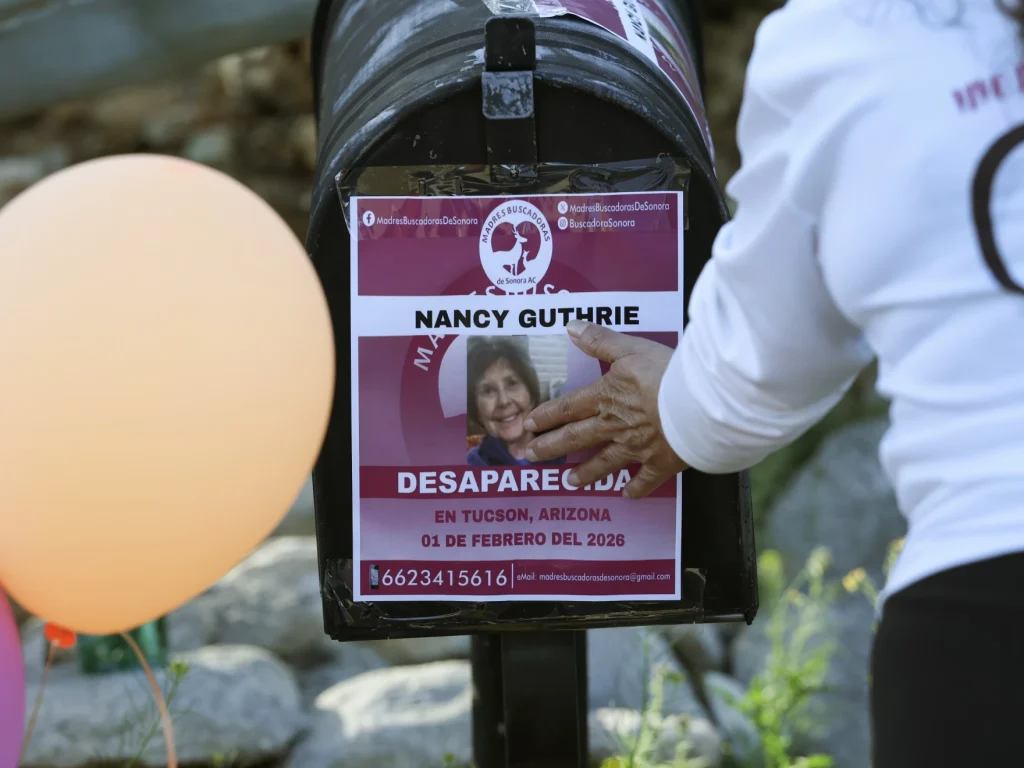



A flyer reading “Nancy Guthrie Desaparecida [Disappeared]” hangs on a mailbox in Tucson, Arizona, as authorities continue searching for 84-year-old Nancy Guthrie, who was last seen on Jan. 31.
For families of missing people, the emotional toll can be overwhelming.
Mickey Shunick knows that pain firsthand. Her sister, Mickey Shunick, was kidnapped in 2012 in Lafayette, Louisiana.
“I can’t think of a more torturous, horrific experience to have as a human being,” she says.
Experts call it “ambiguous loss,” a term coined by therapist Pauline Boss to describe the anguish of losing someone without closure — “a situation that’s beyond human expectation.”
When a loved one disappears, uncertainty can consume daily life.
“They feel like they can’t eat because their child may not be eating. They can’t sleep because their child may not be sleeping,” says Michelle Jeanis, an associate professor at University of Louisiana at Lafayette who studies missing persons cases.
Families must balance searching for answers with maintaining their own lives, all while managing hope and fear about whether their loved one will return.
In Shunick’s case, her sister was ultimately found murdered. But before that tragic discovery — and in cases that remain unsolved — the emotional strain builds over time.
Shunick, now a missing persons advocate, says the same painful dynamics are unfolding in the search for Nancy Guthrie, the mother of Savannah Guthrie.
“They’re going through the same exact things that all these lower-profile family members are,” Shunick says of the Guthrie family. “It’s the same. It’s horrible.”
“Nobody’s Prepared for This”
“Having to mourn without confirmation of whether your loved one is still alive is haunting,” says therapist Emely Rumble, a licensed clinical social worker who has worked on cases involving missing adolescents.
“You don’t want to stop having hope and you don’t want to stop searching for your loved one,” Rumble says. Without clear answers, families can remain “in a state of mental and emotional arrest.”
Jeanis says families often feel pressure to act quickly, even though they have no roadmap.
“Nobody’s prepared for this,” she says. “There’s no handbook on what to do as a family.”
When families reach out to Shunick, she offers what she calls “the trifecta of a successful campaign”: increase community engagement, maintain strong communication with law enforcement and seek media attention.
All three elements reinforce one another, she says.
While some families hesitate to speak with reporters, Jeanis says research suggests media exposure can improve outcomes.
“The research tells us, more eyes on that case, the more likely you are to bring that person home,” she says.
Grassroots Networks Fill Gaps
Not every case receives the same media attention. Advocates note that disparities in coverage persist, and while organizations such as the National Center for Missing and Exploited Children and the Black and Missing Foundation provide critical support, many families of missing adults rely on grassroots networks.
Shunick says she has connected with thousands of families, including some whose loved ones have been missing for more than 25 years.
“We train them on how it works with dog teams and with search and rescue,” she says. “We do a lot of PR stuff, we do a lot of fundraisers and we give family members ideas about how to keep their loved one in the spotlight” on platforms like YouTube and TikTok.
These efforts not only advance searches but also give families a sense of control during a chaotic time.
Key details in Nancy Guthrie’s case — including her age and reported ransom demands — make it unusual. Still, Shunick says the emotional experience remains the same.
“Essentially, you’re panicking, especially when you have no idea what might have happened,” she says.
“Your imagination is truly your worst enemy.”
Jeanis echoes that sentiment.
“When I try to explain what it’s like to be the family of someone who has been missing for a long time, I talk about it like the monster that you can’t see,” she says. “The monster in your head is scarier than the monster you see on TV.”
Coping With a Long-Term Disappearance
More than 500,000 people were reported missing in the U.S. last year, according to the Justice Department. Many cases are resolved quickly, but others stretch on for months or years. After three months, a disappearance is generally considered long-term.
In the early days, adrenaline fuels families. But over time, they must return to daily responsibilities.
“People do have to go back to work. They have to sleep. They have to start eating well and trying to exercise,” Shunick says. “But there’s a guilt that you feel when you deal with any normalcy while your loved one is missing.”
Rumble advises families to find ways to live with uncertainty, such as creating rituals — lighting a candle weekly, journaling to the missing loved one or setting aside space at home to acknowledge grief without requiring final closure.
She also encourages holding two thoughts at once: “I hope they’re alive, and I’m preparing myself for the possibility that they’re not.”
Financial and Emotional Strain
Searching for a missing loved one often brings financial hardship. Shunick estimates her family spent about $50,000 during the nearly three months her sister was missing.
Specialized searches can be costly. A few hours with a canine team can cost around $10,000, and aerial searches can run $10,000 to $15,000.
In Nancy Guthrie’s case, authorities have said DNA evidence and forensic investigative genetic genealogy may help determine what happened. But such methods can be expensive, and families sometimes must raise funds if departments lack resources.
If a case remains unsolved for more than a year and leads dry up, it is typically classified as a cold case, and active investigations slow significantly.
Hoping for Resolution
In the beginning, families focus on bringing their loved one home safely. Over time, priorities often shift.
“When I talk to the families, they say that they would rather visit a grave than have their person remain missing,” Jeanis says.
Some families may even agree to reduced sentences for offenders in exchange for information about a loved one’s remains.
Shunick says she eventually came to understand that perspective.
“At first I was angry because I was like, ‘I’d rather her be missing than dead,’” she says. “But now I’m grateful. We got so lucky, as crazy as that sounds. Because if we never found Mickey, I would still be looking for her.”
Today, she channels her grief into advocacy.
“Obviously, I would trade all of this to get my sister back, no question,” Shunick says. “But in some ways, the network that I’ve become part of and the community that I’ve been able to create has been extremely fulfilling.”

Leave a Reply