
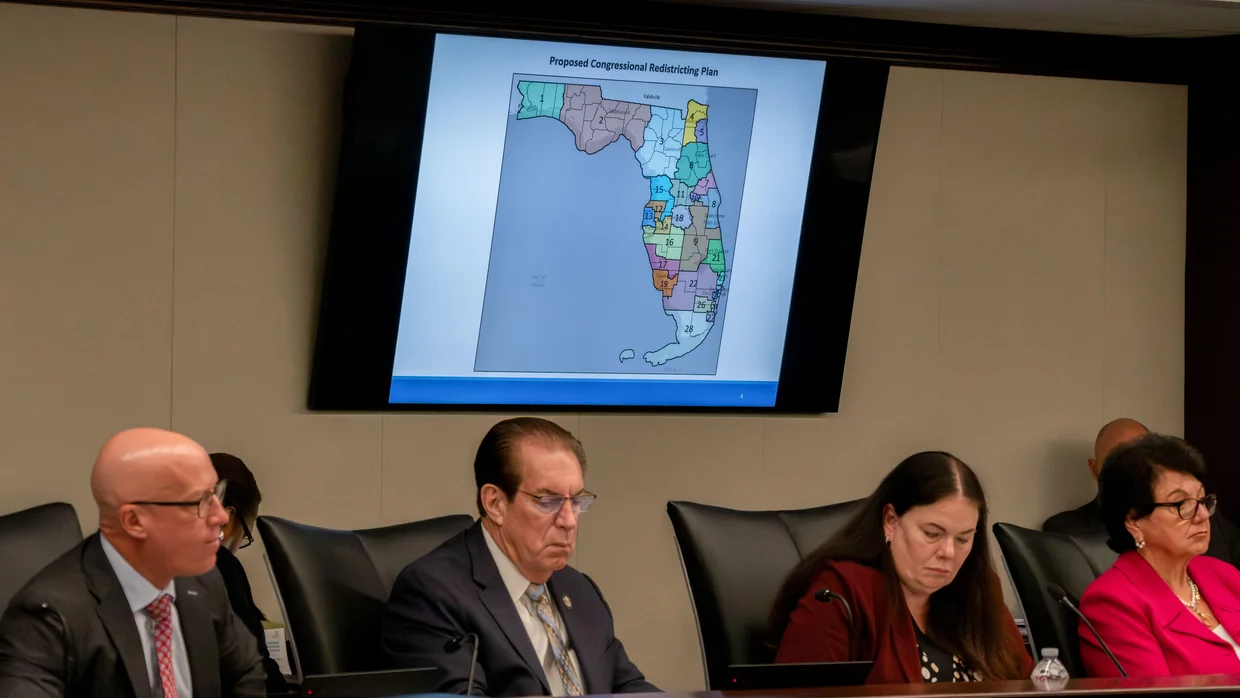
TALLAHASSEE, Fla. — A heated political battle is unfolding in Florida as Republican lawmakers move forward with a controversial plan to redraw the state’s congressional districts, drawing sharp criticism from Democrats who argue the effort is designed to shift political power ahead of upcoming elections.
The proposed redistricting map, backed by Governor Ron DeSantis, was approved by key House and Senate committees this week, setting the stage for final votes. If passed, the changes could significantly alter Florida’s political landscape and potentially strengthen Republican control in the U.S. House of Representatives.
Democrats Raise Constitutional Concerns
Democratic leaders have strongly opposed the proposal, calling it a violation of Florida’s Fair Districts Amendment — a voter-approved measure intended to prevent political gerrymandering.
“This is clearly unconstitutional,” said Senate Democratic Leader Lori Berman, who argued the map unfairly favors Republicans and undermines fair representation.
The amendment prohibits lawmakers from drawing districts that benefit a particular political party or weaken the voting strength of minority communities. Critics say the new plan does exactly that.
Legal Debate Intensifies
Supporters of the proposal argue that recent court rulings have weakened key provisions of the Fair Districts Amendment, giving lawmakers more flexibility in how districts are drawn.
Legal advisors to the governor have pointed to a 2025 Florida Supreme Court decision that struck down parts of the law related to race-based districting. They claim the ruling opens the door for a broader reinterpretation of redistricting rules.
However, even some Republican lawmakers have expressed uncertainty about fully dismissing the amendment’s protections.
Potential Political Impact
The new map could reshape several districts across the state, with projections suggesting Republicans may gain up to four additional congressional seats. This shift could be crucial in determining control of the U.S. House in future elections.
Florida’s rapid population growth — with more than 1.4 million new residents since the last census — has also been cited as a reason for redrawing district boundaries.
Public Reaction and Protests
The proposal has sparked strong public response, with hundreds of residents voicing opposition during hearings and protests at the state Capitol.
Critics argue the process lacks transparency and fairness, especially after reports that details of the map were shared with media outlets before being formally presented to lawmakers.
“This feels like manipulating the system,” said one protester who traveled to Tallahassee to speak out against the plan.
What Comes Next
The redistricting proposal is expected to move to full legislative votes in the coming days. If approved, it could face legal challenges from advocacy groups and Democratic leaders who argue it violates both state and federal protections.
As the debate continues, the outcome could have long-term consequences not only for Florida politics but also for the national balance of power in Congress.