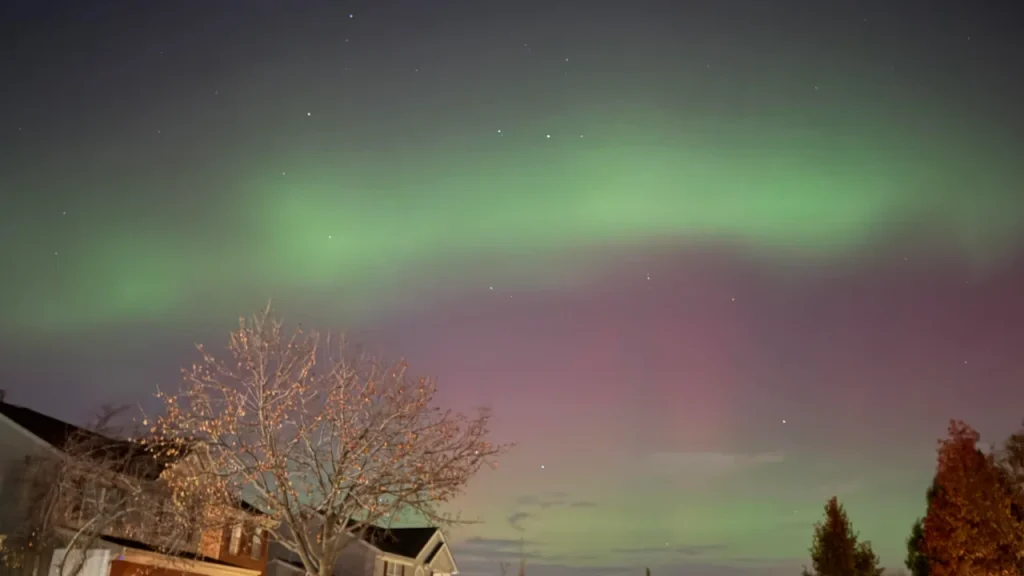



If you’re willing to brave the bitter cold, parts of Illinois may have a chance to see the northern lights Monday night.
The National Weather Service has issued a rare severe, or G4, geomagnetic storm watch for Monday evening, raising the possibility that the aurora borealis could be visible across portions of the state.
While the best viewing chances remain in central and northern Wisconsin, the projected viewing line stretches south into Central Illinois. The likelihood of spotting the lights increases the farther north you travel, especially closer to the Illinois–Wisconsin border.
CBS News Chicago meteorologist Laura Bannon said that if the solar storm arrives at the right time, the aurora could be visible across much of the northern United States after sunset. In northern Illinois, skies are expected to clear before midnight, creating more favorable viewing conditions.
The northern lights occur when charged particles from the sun travel toward Earth and become trapped in the planet’s magnetic field. The sun can release bursts of matter known as coronal mass ejections, or CMEs. One such eruption occurred on January 18 and is expected to reach Earth Monday night, triggering the G4 storm watch into early Tuesday.
As this solar energy interacts with Earth’s magnetic field, it can produce geomagnetic storms. The energized particles then collide with gases in the atmosphere, creating the glowing displays that can sometimes drift south from the polar regions.
The biggest concern for would-be aurora watchers is the extreme cold gripping the Chicago area. Overnight wind chills could feel as low as minus 15 degrees, with actual temperatures dipping into the single digits. Anyone heading out should dress in layers, ensure their vehicle has plenty of fuel, and carry a fully charged cell phone in case assistance is needed.
For the best chance to see the northern lights, experts recommend facing north, getting away from city lights, and using a smartphone camera to look for color in the sky, as cameras can sometimes capture the aurora more clearly than the naked eye.

Leave a Reply