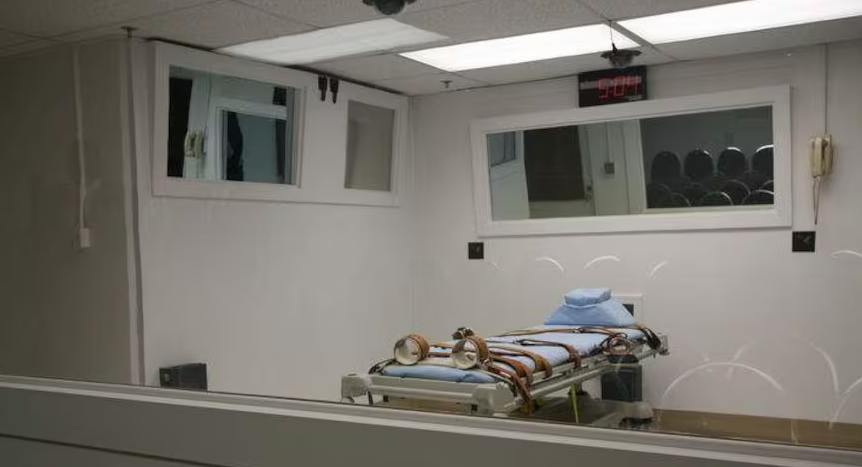


Attorneys for Frank Walls cited prison drug logs and autopsy records to argue that his Dec. 18 execution could be “disastrous.”
The execution chamber at Florida State Prison in Starke is shown as a federal lawsuit seeks to delay an upcoming execution. The suit alleges prison officials used expired drugs and deviated from execution protocols.
Florida Department of Corrections
A federal lawsuit filed for a man set to die next week claims Florida prison officials used expired drugs in at least four recent executions.
The complaint states drug supply logs show executioners may have used lower doses than required by the state’s lethal injection protocol in two other cases.
These findings support a request to halt the Dec. 18 execution of Frank Walls, with the lawsuit accusing the prison system of negligence in administering lethal injection. Attorneys argue Walls will likely experience severe pain similar to torture.
Such an outcome would be “constitutionally repugnant,” wrote Assistant Federal Defender Sean Gunn, who says Walls’ execution would violate the Eighth Amendment ban on cruel and unusual punishment.
Walls faces execution for a 1987 double murder in Okaloosa County.
Florida Department of Corrections
“Mr. Walls is at heightened risk of a disastrous execution in light of (the prison system’s) documented negligence in adhering to their own protocol,” Gunn wrote.
State attorneys responded that Frank Walls,’ arguments are a last-minute attempt to delay his “well-deserved execution.”
“He has been in poor health for years, but waited until the eve of his execution to file suit long after the time to do so had passed,” wrote Assistant Attorney General Jason Rodriguez.
The state’s motion to dismiss did not directly dispute the expired-drug allegation but called his claims of potential pain “speculative” and “tenuous.”
On Tuesday afternoon, U.S. District Judge Mark Walker denied the request to stop the execution. Although he acknowledged evidence suggesting Walls may suffer a cruel death, the judge said Walls could have raised these concerns long before his execution date approached.
Walls’ attorneys quickly appealed.
Drug logs raise questions
Walls, 58, was sentenced to death for killing Edward Alger and Ann Peterson in 1987. Court records say he broke into their home, attacked the couple, bound and gagged them, slashed Alger’s throat before shooting him, and then shot Peterson twice in the head.
Gov. Ron DeSantis signed Walls’ death warrant last month. His execution is set to be Florida’s 19th this year — the highest annual total since the 1970s, when the state reinstated the death penalty. DeSantis recently said the increase helps families of murder victims.
Florida uses a three-drug lethal injection process:
-
Etomidate, a sedative used to induce unconsciousness
-
Rocuronium bromide, a paralytic
-
Potassium acetate, which stops the heart
Courts have upheld the protocol for nearly a decade.
Though the drug suppliers are shielded from public records laws, the Department of Corrections keeps handwritten logs showing drug quantities.
Those logs, Walls’ attorneys say, reveal the state used expired etomidate in four recent executions.
Log sheets indicate the state used etomidate with a Jan. 31, 2025 expiration date during the August and September executions of Kayle Bates, Curtis Windom, David Pittman, and Victor Jones.
A document in the federal lawsuit shows the drug logs noting the expired etomidate.
U.S. District Court for the Northern District of Florida
The logs also show the removal of seven vials of potassium acetate on June 12 — two days after the execution of Anthony Wainwright — suggesting executioners used roughly 41% less than the required dose.
Similarly, logs show the removal of 10 vials of rocuronium bromide a day after the execution of Thomas Gudinas. That amount totals 1,000 milligrams, half the required dose, according to the lawsuit.
The complaint highlights several cases where drugs were logged days after executions, suggesting the records may be incomplete or back-filled.
In the July 15 execution of Michael Bell, logs show no etomidate was removed. However, autopsy toxicology found etomidate in his system, raising questions about where the drug came from.
Another irregularity: lidocaine — not part of Florida’s protocol — appeared in the executions of Edward James and Michael Tanzi in March and April. Its use, the lawsuit claims, shows “improvisation and unpredictability” in the process.
Walls’ attorneys sought a hearing to clarify these inconsistencies but were denied.
The Department of Corrections did not respond to requests for comment.
A ‘dignified death’ versus ‘needlessly cruel’
Florida DOC Secretary Ricky Dixon, along with Florida State Prison Warden Randall Polk, are named in the lawsuit. Dixon regularly reviews and updates the state’s lethal injection procedures.
In February, before the execution surge, Dixon told DeSantis he reviewed the protocol and found it “compatible with evolving standards of decency,” adding that it supports the “dignity of man” and incorporates scientific advances.
“The process will not involve unnecessary lingering or the unnecessary or wanton infliction of pain and suffering,” Dixon wrote, calling the goal a “humane and dignified death.”
Four months before DeSantis signed the warrant, Walls suffered a rapid health decline marked by dizziness and shortness of breath.
Court documents include an affidavit from Dr. Joel Zivot, an Emory University anesthesiologist who evaluated Walls. Zivot reports Walls suffers from heart disease, high cholesterol, thyroid problems, obstructive lung disease, chronic back pain, and morbid obesity at over 350 pounds.
Zivot argues Walls’ health issues increase the risk of complications, particularly pulmonary edema, a buildup of fluid in the lungs.
Zivot states the drugs may cause Walls’ lungs to fill with blood, comparing the sensation to drowning or suffocation. He wrote that prisoners in this condition “choke on their own blood.”
“Mr. Walls will die a needlessly cruel death if Florida insists on trying to kill him with Florida’s version of lethal injection,” Zivot wrote.
Walls’ attorneys cited similar outcomes in other executions, including cases where prisoners developed pulmonary edema and autopsies revealed heavy, fluid-filled lungs. One cited example is Byron Black, executed in Tennessee, who told his spiritual adviser, “It’s hurting so bad.”
Witnesses in several Florida cases also described prisoners heaving and twitching as they died.
The state counters that a large initial dose of etomidate will render Walls unconscious in under a minute, making any later pain “irrelevant.”

Leave a Reply