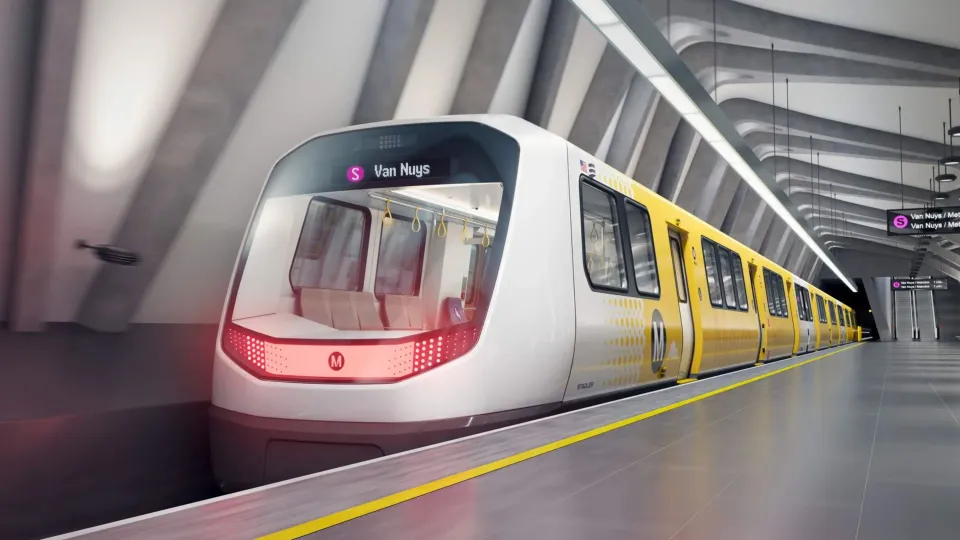

The Los Angeles County Metropolitan Transportation Authority unanimously approved a high-speed underground rail project Thursday that will connect the San Fernando Valley and the Westside through the Sepulveda Pass, a move aimed at easing congestion in one of the region’s most traffic-clogged corridors.
The project, known as the Sepulveda Transit Corridor, is intended to provide an alternative to the heavily traveled 405 Freeway, where Metro officials estimate roughly 400,000 drivers commute daily between the Valley and the Westside. The rail line has a target completion date of 2033.
Supporters say the new line could reduce travel times between the two areas to about 20 minutes, a sharp improvement over rush-hour drives through the pass. Metro officials have previously noted that Valley commuters alone lose an average of 59 hours each year to traffic delays on evening trips between Wilshire and Ventura boulevards.
The project traces its origins to 2016, when voters approved Measure M, which allocated funding for major transportation upgrades, including a transit connection between the Valley and the Westside.
The approved plan, known as Locally Preferred Alternative 5, calls for an automated underground heavy-rail system spanning approximately 14 miles. The line would connect with the Metro E, D, and G lines and include an additional station at UCLA.
The proposal replaces earlier monorail concepts and eliminates a planned Getty Center station, opting instead for a subway-style alignment designed to move riders more efficiently through the Sepulveda Pass while minimizing surface disruption.
“This is an important and exciting moment for Los Angeles,” said Katy Yaroslavsky, a city councilwoman and Metro board member. “There’s still a lot to do until we get shovels in the ground, let alone open this thing — but I’m not sure that there’s been a project this transformative since the L.A. Aqueduct.”
Despite broad regional support, significant funding challenges remain. The Los Angeles Times reports that about $3.5 billion has been secured through Measures M and R, but billions more will be required to fully build the project.
Cost estimates have increased substantially since 2016, and Metro has not yet released an updated price tag for the current plan.
Even so, local officials speaking in Van Nuys ahead of the vote highlighted the project’s potential to benefit students, workers, and families who currently depend almost entirely on cars to travel through the Sepulveda Pass.

Leave a Reply